January 1, 2026
Educational
Educational
A practical, conservative art investment guide for collectors, beginner investors, and HNWIs who want to buy contemporary art in 2026 with confidence.

What if a painting wasn’t an image, but an unfinished sentence? In Ludovic Dervillez’s work, the canvas does not illustrate: it notes, scratches out, hesitates, and begins again. Through gestures that are both instinctive and sharply deliberate, his paintings become spaces of inscription—where every mark is a choice, and every silence a breath.
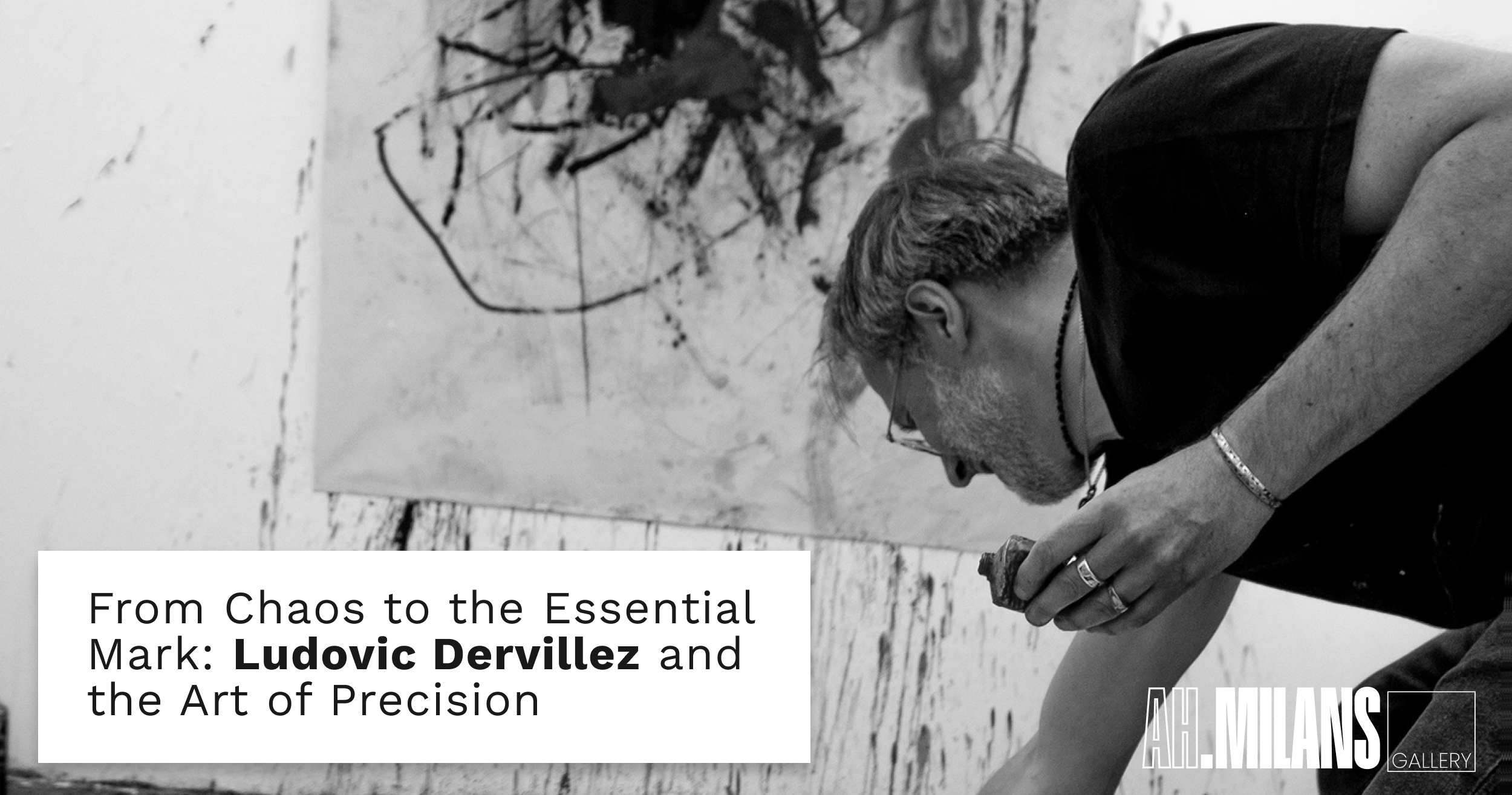
What if a painting wasn’t an image, but an unfinished sentence? In Ludovic Dervillez’s work, the canvas does not illustrate: it notes, scratches out, hesitates, and begins again. Through gestures that are both instinctive and sharply deliberate, his paintings become spaces of inscription—where every mark is a choice, and every silence a breath.
Some paintings offer immediate recognition: a face, a landscape, a scene. They provide a visual anchor, something familiar to hold onto. And then there are paintings like Ludovic Dervillez’s—works that refuse that comfort. Not out of provocation, but because they are searching elsewhere.
Standing in front of his canvases, the eye doesn’t settle on a single object. It moves. It investigates. It follows a line, collides with a block of color, returns to a faint trace, notices a scrape, an erasure, a drip. These paintings do not “tell a story” in the traditional sense. They are surfaces where something has occurred.
Ludovic Dervillez himself expresses this with a striking simplicity: “Every time I move forward, I write.” That sentence unlocks much of his practice. Painting here is not about producing an image—it is about moving through a space, recording gestures, and allowing a form of thought to emerge in motion.
What we see is not only the final outcome. We witness the trajectory.
And that trajectory is rarely calm.
There is a constant tension in this work: between what appears unexpectedly and what is controlled, between the accident of matter and the painter’s decision-making, between disruption and refinement. The canvas becomes a field where something is negotiated—something close to a truth of gesture.
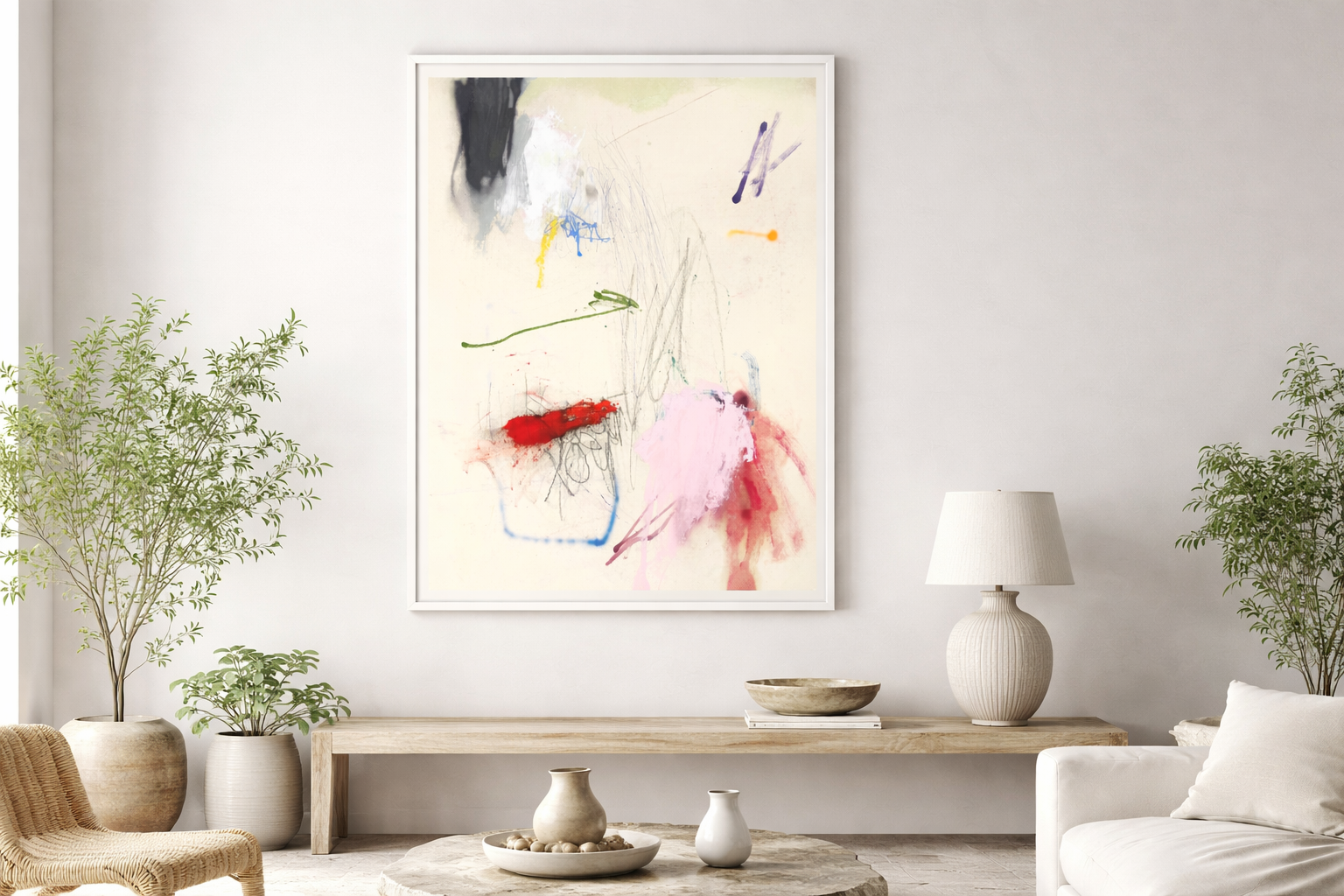
Ludovic Dervillez does not approach painting as a surface to fill, but as a place where stages accumulate. There is something almost physical in this idea: as if the canvas records speeds, shifts of intention, impulses, and corrections.
In the text associated with his work, it is said clearly: each painting becomes a space where “something is noted down, crossed out, displaced, written.” This is not metaphorical. It is visible.
Nervous lines, repeated strokes, marks that resemble scratches, layers that cover other layers without fully erasing them—the painting is not a clean surface. It is memory.
In his earlier works, Ludovic goes through a phase of accumulation. The gestures appear repeated, sometimes forceful, almost aggressive. But it would be too easy—and misleading—to romanticize this as the cliché of the “tormented artist.”
The accompanying text suggests something far more compelling: saturation is not obsession, but a recognition of inability—an inability to stop, to decide which mark is the right one, which gesture deserves to remain.
In other words: the canvas becomes dense because the search is unfolding in real time. Because the painting does not yet know what it wants to be.
And that hesitation is precisely what makes these works feel alive. The signs never settle into a stable form. They remain active, vibrating, unfinished—always “in the process of becoming.”
Then something begins to change. Not a rupture, but a subtle reorientation.
Ludovic Dervillez's more recent work moves toward clarity, breath, and a kind of minimalism. But this minimalism is not decorative. It is not a fashionable “cleaning up” of style. It is presented as a demand—an artistic necessity.
Because writing is not simply adding more.
To write is also to choose.
This becomes the key to understanding his evolution. The canvas transforms into a space of decision-making. What is necessary? What can disappear? What must remain?
In this new economy of marks, emptiness becomes as important as gesture. The white spaces are no longer “unpainted.” They are silences, deliberately constructed.
And painting begins to function like a personal language: a form of calligraphy without a fixed alphabet.
Ludovic Dervillez states that “the figurative confined me.” This sentence is crucial. It reveals what is at stake: rejecting figuration is not rejecting reality—it is rejecting the obligation to deliver an immediate, readable object.
Figurative painting imposes a quick interpretation. It assigns meaning too fast.
He seeks an open painting: one that remains readable as gesture before becoming readable as motif.
He does not paint an object.
He paints a dynamic.

Ludovic Dervillez’s work does not tell an external story. It reveals an internal trajectory made visible. A painting that does not aim to represent, but to inscribe—leaving proof of movement, gesture, and choice.
From dense, saturated canvases to more open and airy works, we do not see an artist calming down. We see an artist refining—moving from excess to precision, not to become “simpler,” but to become truer.
And in front of these paintings, the viewer is invited to do the same: slow down, follow the signs, accept not understanding immediately, inhabit the blank spaces.
Ultimately, the real question is not: what does this represent?
But rather: what does it awaken in me?
Perhaps that is the true power of this painting: it reminds us that an artwork can be a space of reading—not reading an image, but reading a living movement.
A practical, conservative art investment guide for collectors, beginner investors, and HNWIs who want to buy contemporary art in 2026 with confidence.

Sebastien Cheramy emerges as a singular voice in the contemporary art scene, his canvases a dance of color and form that challenge the viewer to move beyond the superficial and engage with the depth of emotion and the complexity of the human psyche.

Street art, once perceived as mere vandalism, has undergone a remarkable transformation. It's now celebrated as a powerful form of cultural expression and a valuable collectible art form.